

What are the container gardening essentials, really?
The essentials are a container with drainage, a substrate that holds both water and air, and a watering routine matched to the pot’s volume and the plant’s root mass. Everything else — fertilizer type, mulch, pot colour — is secondary to getting those three right, because a container is a closed system with no subsoil reserve to fall back on.
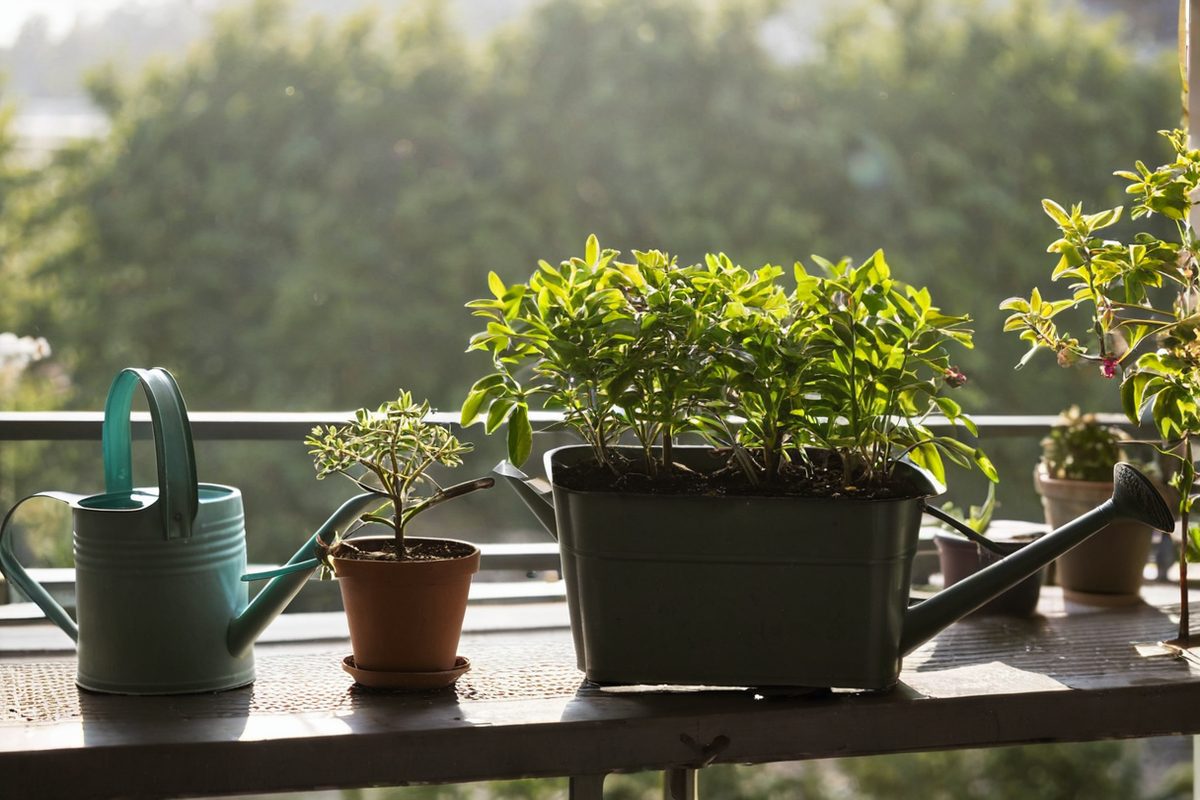
Most failures in pots are water failures, not nutrient failures. A plant in a 10 L pot may drain away 20–40% of the water you pour in within the first hour, and the remaining moisture sits in a narrow band that roots can only partly reach. Understanding that band — and how your substrate changes it — is the whole game.
The detail most people miss: water-holding capacity, not “good drainage”
Gardeners are told to use “well-draining” mix, which is correct but incomplete. The useful number is how much plant-available water a substrate holds per litre, and how much of it stays available between field capacity and the wilting point. Coir and peat both hold roughly 8–10 times their dry weight in water; coarse bark holds far less; perlite holds very little but creates the air space roots need to respire.
The missed detail is that these components behave differently under compression and repeated drying. A peat-based mix that has dried out hard can become hydrophobic — water channels down the pot wall and out the drainage hole while the root ball stays dry. Coir tends to rewet more readily. This is why growers who switch from peat to coir often report needing to water more often in the first weeks, then less once the coir is fully hydrated and the root system has filled the pot.
Water-holding additives sit on top of that base. Super-absorbent polymer granules, typically dosed at 0.3–0.8% of substrate weight for container mixes, can extend the interval between waterings, but they change the physics of the pot: the gel holds water at a tension the plant can only partly access, and over-dosing can leave roots in a permanently damp, low-oxygen zone. Formulators usually tune potassium-based polyacrylate grades for this reason, and the differences between grades are worth reading up on in super absorbent polymer technical notes before you buy a drum.
Why pot volume matters as much as mix
A small pot dries faster per unit of leaf area, and the effect is not linear. Doubling pot diameter roughly quadruples surface area at the rim but increases volume eightfold, so a wider pot buffers moisture swings much better than a taller narrow one of the same volume. Shallow, wide containers also expose more substrate surface to evaporation — a trade-off worth thinking about.
A worked example: one 30 cm pot, one tomato
Take a 30 cm diameter pot, 30 cm deep. That is roughly 21 L of substrate by volume, and it will settle to about 18–19 L after watering. Fill it with a mix of 60% coir, 25% composted bark fines, 10% perlite and 5% vermicompost by volume — a common home-gardening blend that balances water holding against air space.
- Pre-hydrate the substrate. Dry coir can absorb several times its weight in water but wicks slowly. Wet it thoroughly in a bucket, break up clumps, and let it stand 20–30 minutes before filling the pot. Dry-filled pots can stay hydrophobic for weeks.
- Leave 3–4 cm of headspace. This is the watering reservoir. Pots filled to the rim spill water and lose substrate over the edge.
- Check the drainage hole. One hole of 15–20 mm is usually enough for a 20 L pot; drill a second if the base is flat and the hole sits proud of the lowest point.
- Water to runoff on the first pass. Apply 2–3 L slowly, wait 10 minutes, apply again. Runoff confirms the whole profile is wet rather than just the top 5 cm.
- Weigh or lift the pot. A 20 L pot at field capacity with a young tomato weighs roughly 20–24 kg. Lifting it tells you more than poking a finger in. When it feels noticeably lighter — often 3–5 kg lighter — water again.
- Mulch the surface with 2–3 cm of bark or straw. This cuts surface evaporation meaningfully in hot weather and keeps the top roots cooler.
In summer, that pot under a tomato in full sun may need 2–4 L per day at peak. In a heatwave with temperatures above 32 °C, twice-daily watering is not unusual for a fruiting plant in a 20 L container. If you are planting from seed rather than transplants, the same pot volume logic applies but the moisture target changes — seed coating formulations and germination media are designed for a much narrower moisture window than a growing-on substrate.
Comparing container setups
| Setup | Typical pot volume | Watering interval (summer, full sun) | Main risk | Notes |
|---|---|---|---|---|
| Herb pot, windowsill | 2–4 L | 1–2 days | Drying out fast | Small volume, little buffer |
| Patio tomato, single stem | 18–25 L | 1 day, sometimes 2× | Blossom end rot from uneven moisture | Mulch and consistent schedule help |
| Bush bean or pepper | 10–15 L | 1–2 days | Waterlogging in poor mix | Needs good air-filled porosity |
| Salad leaves, cut-and-come | 8–12 L | 1–2 days | Bolting under moisture stress | Shallow roots, sensitive to swings |
| Small fruit tree, dwarf | 40–60 L | 2–3 days | Root restriction long term | Repot or root-prune every 2–3 years |
Figures are for reference and vary with climate, wind, substrate and cultivar. Coastal wind can double water loss compared with a sheltered courtyard at the same temperature.
Where this breaks down
Substrate water-holding advice assumes the pot is outdoors in reasonable light and the plant is actively growing. Several situations break the model.
Indoor and low-light conditions. A pot on a north-facing windowsill uses far less water than the same pot outside, and the risk flips from drought to waterlogging. The lift-the-pot test still works, but the interval stretches to a week or more in winter. Root rot in indoor containers is usually a watering-frequency problem, not a drainage-hole problem.
Very hot, windy sites. Above roughly 35 °C with wind, transpiration can outrun what a 20 L pot can supply, and no additive fixes it. Shade cloth, pot-in-pot, or moving the container to afternoon shade does more than any substrate amendment.
Long-term plantings. Substrate structure degrades. Coir and peat break down, air porosity drops, and by year two or three a mix that started at 15% air-filled porosity may be closer to 8%. For perennials and small trees, plan on repotting or top-dressing with fresh mix annually. There is more on long-term container performance in the home gardening container resources.
Fertilizer interactions. High-salinity fertilizer regimes in small pots can pull water away from roots osmotically, and slow-release prills release faster in warm, wet substrate than the label suggests. In a 20 L pot, a typical controlled-release product at 3–5 g per litre of substrate is usually adequate for 8–12 weeks; doubling it does not double growth and can burn roots.
What to check in your own case
- Drainage: at least one unobstructed hole, and no gravel layer at the bottom — it raises the saturated zone rather than improving drainage.
- Volume against plant size: match pot litres to expected mature root mass, not to the seedling you are planting.
- Substrate composition: aim for a mix with roughly 60–70% water-holding organic matter and 20–30% coarse aggregate by volume.
- Water quality: hard water above about 250 mg/L calcium carbonate leaves crust on the surface and can lock up micronutrients over a season.
- Mulch: 2–3 cm on the surface, kept clear of the stem.
- Weight test: lift the pot before and after watering once, so you learn its dry and wet weight.
- Seasonal plan: decide now whether the pot is a one-season annual or a multi-year planting; the substrate and volume choice differ.
Frequently asked questions
Do I need a saucer under the pot?
Outdoors, usually not — a saucer keeps the base saturated and reduces air exchange. Indoors, use one but empty it 30 minutes after watering so the pot is not standing in water.
Is a bigger pot always easier?
Larger pots buffer moisture better, but they also hold more water in the lower zone, which can stay anaerobic if drainage is poor or the plant is small. Match pot size to the plant’s mature root system rather than going as large as possible.
Can water-holding granules replace regular watering?
They extend the interval, not the schedule. Typical field results show a meaningful reduction in watering frequency, but a potted tomato in peak summer still needs checking daily. Dose conservatively and mix granules evenly through the substrate rather than concentrating them near the root ball.
Practical note: if you are sourcing substrate components, water-holding polymers or seed-coating materials for a container-gardening line, send your target dose rate, pot volume range, climate zone and any certification requirements, and we can match specifications to a trial batch.