

Container gardening for beginners: the short answer
Container gardening means growing plants in a defined volume of free-draining potting mix rather than in garden soil, and for beginners the essentials are a pot with working drainage, a mix that stays airy when wet, and a watering routine matched to a small root zone. Get those three roughly right — about 20 L of mix and 30 cm of depth for a bush tomato, a blend of roughly 60% coir or peat with 25% perlite and 15% compost, and a check 2–3 cm below the surface before watering — and most first-season failures simply do not happen.
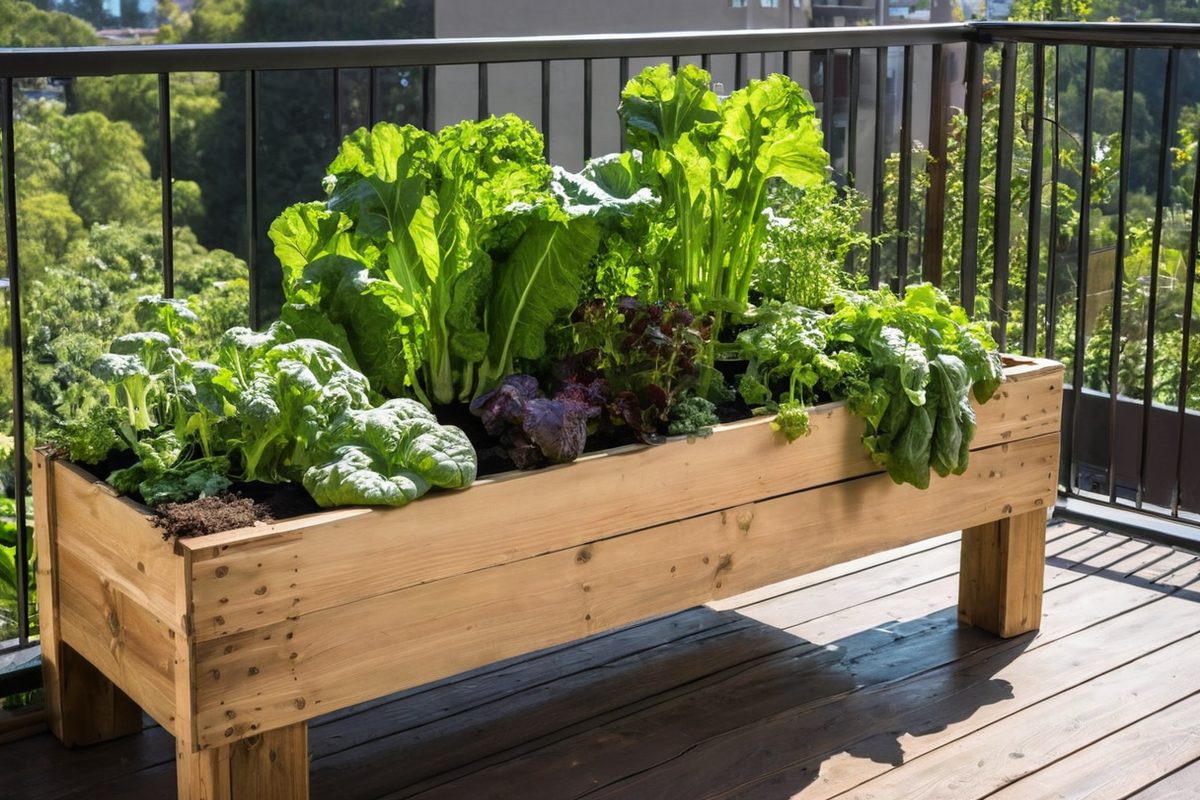
How container gardening actually works
A pot is a closed root environment with a fixed supply of water, air and nutrients, and roots need all three at once. After drainage, roughly 20–30% of the mix volume should be air-filled pore space, with the rest holding water and solids. When those air pores stay full of water, roots suffocate and root-rot organisms take over — which is why drainage, not watering skill, is the first thing to fix.
Water also behaves differently in a container. Capillary action lifts water upward from the saturated zone at the base of the pot, but in most mixes it can only raise it 20–30 cm, so a 40 cm deep pot dries at the surface while the bottom stays wet. That is why a small pot in July may need water twice a day while a deep one still feels damp below. Every watering also pushes dissolved nutrients past the root zone and out of the drainage holes — a leaching loss that open garden soil largely buffers.
Garden soil is the classic beginner error. Field soil in a pot compacts into a dense mass with almost no air pores, then shrinks away from the pot walls so water runs down the gap and straight out. Potting mixes are built from coir or peat with perlite, bark and compost specifically to hold structure under repeated wetting and drying.
What the numbers mean
For container gardening for beginners, two figures matter more than any other: volume and depth.
Volume in litres largely sets how often you water. Doubling pot volume roughly halves watering frequency for the same plant, because the water reserve grows faster than the leaf area drawing on it. A 5 L herb pot may need daily attention in midsummer; a 25 L tomato pot can often go two to three days.
Depth matters more than width for anything with a taproot or a tall canopy. Shallow bowls dry fast and blow over, while deep pots are stable and keep the root zone cooler. A practical rule is depth equal to at least 25–30% of the plant’s expected height, and never under 15 cm for a full-season crop.
Drainage is counted in holes, not in a layer of gravel. Aim for at least one hole of 1–2 cm diameter per 10 L of mix, or several smaller holes with the same total area, and raise the base 1–2 cm off the ground so water can actually leave.
Fertiliser ratios are read as N-P-K. A 3-1-2 ratio suits most container crops because it roughly tracks nitrogen and potassium uptake. Liquid feeds are typically mixed at 1–2 g per litre and applied every 7–14 days during active growth; controlled-release granules are usually blended into the mix at 3–5 g per litre before planting.
Water-retention additives are dosed by dry weight of mix. Super absorbent polymer granules are typically used at 0.1–0.3% of mix weight — about 1–3 g per litre — pre-hydrated before blending so they swell evenly. In free-draining mixes they commonly extend the interval between waterings by 30–50%; the gain is smaller in humus-rich mixes that already hold water well. Dose ranges and behaviour are covered in more depth under super absorbent polymer for growing media.
| Crop | Minimum volume | Minimum depth | Summer water, typical | Notes |
|---|---|---|---|---|
| Lettuce, spinach, chard | 5–8 L per plant | 15–20 cm | 0.5–1 L per week | Shallow roots; bolts in heat |
| Basil, mint, parsley | 4–8 L per plant | 15–20 cm | 0.5–1.5 L per week | Pinch flowers to keep leaves coming |
| Bush tomato | 20–30 L | 30–40 cm | 4–7 L per week | Stake early; steady moisture limits splitting |
| Chilli or sweet pepper | 12–20 L | 25–30 cm | 3–5 L per week | Tolerates a slightly drier mix than tomato |
| Cucumber, courgette | 25–40 L | 30–40 cm | 6–10 L per week | Fast growth; feed weekly |
| Carrot, radish | 10–15 L | 25–30 cm | 1–2 L per week | Stone-free mix; thin seedlings early |
| Strawberry | 5–8 L per plant | 20 cm | 1–2 L per week | Works well in troughs and baskets |
Figures are for reference and assume full sun, a 20–25 °C average and an aerated mix. In wind, above 30 °C, or with a dark pot in direct sun, add 30–60% to those water volumes.
How to choose or apply it: a build sequence
- Pick the pot by crop, not by look. Work back from the table — 20 L for a bush tomato, 5–8 L for herbs. Terracotta dries faster than plastic or glazed ceramic, and light colours stay cooler in strong sun.
- Fix drainage before anything else. Drill or enlarge holes to the 1–2 cm per 10 L rule and stand the pot on feet or two bricks. Skip the gravel layer; it raises the saturated zone rather than improving it.
- Mix your own or buy a known blend. By volume, roughly 60% coir or peat, 25% perlite and 15% mature compost, plus slow-release feed at 3–5 g per litre. Target pH 5.8–6.5 for most vegetables.
- Pre-hydrate any polymer additive. Soak granules in clean water for 20–30 minutes until fully swollen, then blend at 1–3 g dry weight per litre of mix. Never scatter dry granules on the surface, where they can pull moisture from the root zone.
- Fill and settle, don’t compact. Leave 2–3 cm below the rim as a watering reservoir and firm only enough that the mix stops settling.
- Plant level and water in thoroughly. Set transplants so the top of the root ball sits level with the mix, then water until it runs from the base — the first watering needs to close air pockets.
- Mulch the surface. A 2–3 cm layer of bark, straw or compost cuts surface evaporation and keeps the root zone cooler.
- Feed on a schedule. Begin liquid feeding 2–3 weeks after planting, as the slow-release charge fades, then continue weekly through fruiting.
Small-space layouts, crop combinations and pot groupings are covered in the home gardening guides, which are a sensible next read once your first containers are planted.
Common mistakes
Most problems beginners hit in container gardening fall into a short list, and nearly all of them are structural rather than bad luck.
- No drainage, or a saucer left full. Roots sitting in water for a day or more can show damage within days. Empty saucers after rain.
- Using garden soil. It compacts, shrinks and brings weed seed and soil-borne problems with it.
- Watering by habit instead of by check. Push a finger 2–3 cm into the mix; water only when it is dry at that depth. Daily watering in cool weather is a common route to root rot.
- Undersized pots. A tomato in 5 L survives and produces very little. Pot volume sets much of the ceiling on yield.
- Feeding at planting. Strong liquid feed against fresh roots can burn them. Wait 2–3 weeks, then feed steadily.
- Dark pots in full sun. Surface mix in a black pot can run 10–15 °C above air temperature, which stresses roots. Shade the pot or choose a lighter colour.
- Crowding. Three seedlings where one belongs is the most common spacing error. Follow the packet and thin without sentiment.
Comparing products is easier when you know which numbers matter; our buying guides for garden inputs explain how to read mix, feed and additive labels side by side.
Frequently asked questions
How often should I water containers?
In warm weather, most 10–20 L containers need water every one to three days, and small herb pots may need it daily. Water until it runs from the base, then let the top layer dry slightly before the next round.
Can I fill pots with compost alone?
Not as the whole fill. Compost alone is dense and holds too much water; use it at roughly 10–20% of the mix volume and bulk out the rest with coir or peat and perlite.
Do water-retention granules actually help?
In free-draining mixes they typically reduce watering frequency by around 30–50%, which matters most in small pots and hot spells. They do not compensate for poor drainage and add little to a mix that already retains water well.
Practical note: if you are sourcing containers, potting mixes or water-retention additives for a retail range or a commercial growing operation, send your pot volumes, target crops and climate conditions and we will match specifications, dose rates and packaging options to your market.