

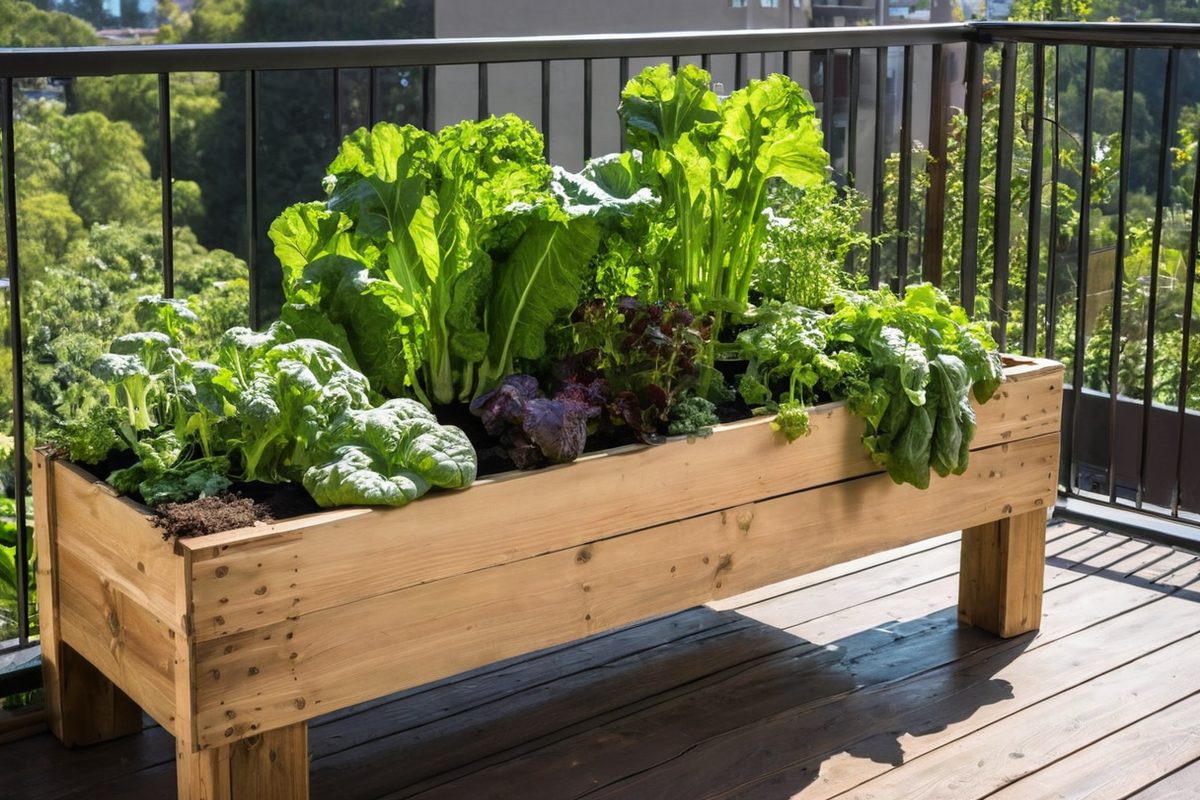
Raised bed garden boxes are open-bottomed frames — typically 20–45 cm deep and no wider than 120 cm — filled with a blended growing medium and sitting on existing ground. The frame gets the attention, but depth, width, drainage and what you fill it with decide how the bed actually performs. For most vegetable growers, a 30 cm deep, 120 cm wide box filled with roughly 50–60% topsoil, 25–30% compost and 10–20% perlite or coarse sand covers the widest crop range at a sensible cost.
How it actually works
A raised bed is a controlled root zone rather than a decorative border. Because the mix sits above grade, it drains freely, warms earlier in spring — often one to two weeks ahead of surrounding ground on the same site — and stays aerated because nobody walks on it. That last point is easy to underestimate: an uncompacted 30 cm profile can support better root growth than 60 cm of compacted garden soil.
The trade-off is water. Free drainage means fast loss, and the top 15 cm of a raised bed can dry out within a day or two in hot, windy weather. Most growers handle it in three layers: a 5–7 cm organic mulch, drip irrigation on a timer, and — where water is scarce or the mix runs sandy — a retention amendment blended into the top 20–25 cm. For potassium polyacrylate types, a working rate is typically 0.5–2 g per litre of growing mix, mixed through the soil rather than scattered on the surface; the differences in swelling capacity and field life are covered in our notes on super absorbent polymer grades for soil.
Vertical space is the second lever. A raised bed garden arch trellis — a hoop or rigid panel 2.1–2.4 m tall spanning the path between two beds — can add roughly 30–50% more usable growing area per square metre of ground without widening the bed. Cucumbers, pole beans, peas and indeterminate tomatoes all suit it. Anchor the structure against wind: posts set 40–50 cm into the ground, or the frame bolted to the box itself.
Protection is the third. A raised bed garden cover of insect mesh or spun row cover on low hoops keeps cabbage white butterflies and flea beetle off brassicas, and heavier grades lift night temperature by a few degrees. In midsummer, 30–50% shade cloth keeps lettuce from bolting.
What the numbers mean
Depth is the first number buyers ask about, and the one most often overbought. It is root depth, not frame height, that sets the limit — and the volume of mix you have to buy, wheelbarrow and eventually top up.
| Depth | Crops that fit | Mix volume, 1.2 × 2.4 m bed | Notes |
|---|---|---|---|
| 15 cm | Lettuce, herbs, radish, scallions | ~430 L | Needs decent subsoil contact below |
| 25–30 cm | Beans, onions, peppers, most greens | 720–860 L | The common default for mixed beds |
| 40–45 cm | Tomatoes, carrots, brassicas, potatoes | 1,150–1,300 L | Carrots want a fine, stone-free mix |
| 60 cm+ | Dwarf fruit trees, deep roots, waist-height beds | 1,700 L+ | Check load capacity on decks and roofs |
Volume follows directly from length × width × depth. That 1.2 × 2.4 m bed at 30 cm holds about 0.86 m³ — roughly 860 litres — which is why filling from bags gets expensive fast and most growers blend their own or buy by the cubic metre.
Width governs reach. 120 cm is the usual maximum because an adult can comfortably reach the middle from either side; drop to 60–75 cm where the bed backs onto a wall and is only accessible from one side. Height governs your back: soil level at 45–60 cm suits most standing work, while 75–90 cm is the accessible range for anyone who wants to avoid bending.
Cover figures are worth knowing before you buy. Clear 6 mil polyethylene over a hooped frame typically holds 3–5 °C above outside night temperature — enough to carry lettuce through a light frost, not enough for tomatoes in a hard freeze. Insect mesh of roughly 1 mm aperture excludes most pests but also blocks pollinators, so it comes off at flowering for fruiting crops.
How to choose or apply it
- Site first. Six or more hours of direct sun for fruiting crops, level ground, and within hose or drip-line reach of water.
- Draw the layout. A raised bed garden layout works best with main paths of 50–60 cm for a wheelbarrow and secondary paths of 35–45 cm. Run the long axis east–west in northern latitudes for even light, and aim for roughly 60:40 bed to path.
- Fix the size. 120 cm wide, 25–30 cm deep, and lengths in multiples of your board or panel stock to cut waste.
- Choose the frame. See the comparison below; lifespan and cost per year differ far more than the sticker price suggests.
- Line and protect. Cardboard or a single layer of geotextile suppresses existing grass without sealing drainage. Add 6–12 mm hardware cloth if voles are a problem.
- Fill in layers. Loosen the base, then add the blended mix, leaving 2–3 cm of headspace for mulch and settlement.
- Irrigate and mulch. One or two drip lines per 120 cm bed, on a timer, plus 5–7 cm of mulch.
- Add cover and trellis last, once you know where paths and tall crops will sit.
| Frame material | Typical service life | Relative cost | Watch out for |
|---|---|---|---|
| Untreated pine | 3–5 years | Low | Rots at the soil line; plan to rebuild |
| Cedar or larch | 10–15 years | Medium | Check for heartwood, not sapwood boards |
| Galvanised steel | 15–20+ years | Medium–high | Heats up in strong sun; use a liner |
| HDPE or plastic panels | 10–15 years | Medium | Can bow under mix weight without bracing |
| Concrete block | Decades | Low per year, high upfront | Heavy; thermal mass shifts soil temperature |
For a raised bed garden diy build, a 1.2 × 2.4 m box from 5 × 15 cm boards needs four sides plus two or three internal corner stakes driven 30 cm into the ground — that bracing, not thicker boards, is what stops the sides bowing once the mix is wet. If you are assembling from scratch, the home gardening project guides walk through cut lists and frame assembly in more detail.
Where winters are cold, a raised bed garden greenhouse conversion — hoops over the box plus a poly or twin-wall polycarbonate cover — extends the season by roughly four to six weeks at each end. Ventilation matters more than insulation here: an unvented covered bed can exceed 30 °C on a sunny March afternoon and cook young plants.
Common mistakes
- Filling with nothing but compost. It shrinks 5–10% a year, runs high in soluble salts and has weak structure. Use it as 25–30% of the blend.
- Building wider than you can reach. A 150 cm bed looks generous until you are standing in it.
- Sealing the base. Solid bottoms trap water and turn the box into a bog. If you need a barrier, use mesh or fabric, never sheet plastic.
- Skipping weed suppression underneath. Perennial grass and bindweed will find the seams within a season.
- Underestimating water. A raised bed without mulch and drip typically needs more frequent irrigation than open ground, not less.
- Over-deepening for shallow crops. Salad and herbs gain nothing from 45 cm of bought mix.
- Leaving hoops and trellis unanchored. A covered bed presents real sail area in a gale.
- Forgetting settlement. Expect to top up 2–5 cm of mix after the first season and less each year after.
Frequently asked
Do raised bed garden boxes need a bottom?
No. Open bottoms let excess water drain and roots reach subsoil moisture. Use hardware cloth or geotextile only as a barrier against burrowing pests and perennial weeds, and avoid solid bases unless the bed sits on a hard surface, in which case add drainage holes and a gravel layer.
How much soil does a raised bed need?
Multiply length × width × depth in metres to get cubic metres, then multiply by 1,000 for litres. A 1.2 × 2.4 m bed at 30 cm needs about 0.86 m³, or roughly 860 litres; allow another 5% for settlement.
Can I put a raised bed on concrete or a patio?
Yes, provided the bed has drainage holes, a gravel or drainage-mat layer, and the slab or deck can carry the load — saturated mix weighs roughly 1,000–1,300 kg per cubic metre. Keep depth at 30–40 cm on hard surfaces and expect faster drying than a bed on soil.
If you are sourcing frames, covers, irrigation fittings or retention additives for a retail range or a commercial growing project, send us your target dimensions, climate, crop list and pack sizes — we can quote against a specification rather than a generic catalogue number.